

Traditional or Modern Snowshoes? Choosing the Right Pair for Algonquin
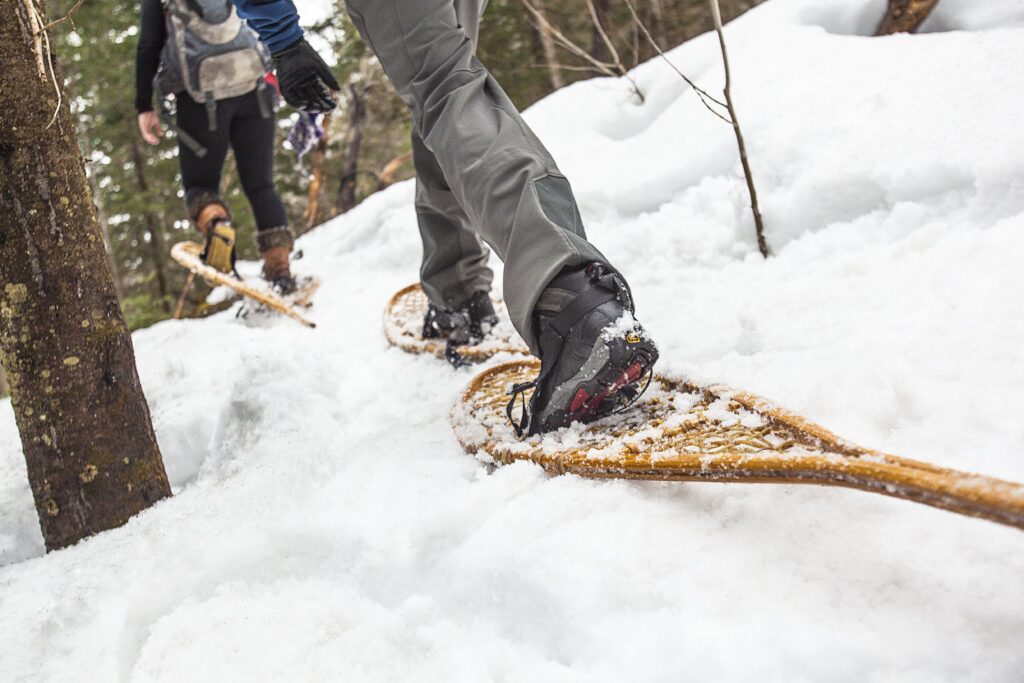
I was snowshoeing at a ski club in Collingwood with a friend. We each brought our own snowshoes. I brought my Ojibways. He brought what I can best describe as cleats that slipped over his shoes. Not boots, shoes. We each laughed at the other’s choice.
So which was better for the day? His. We “snowshoed” a well-used, packed trail, and my snowshoes were unnecessary. Regular boots would have worked, except on the hilly sections.
Had that same trail been under two feet of fresh snow, my Ojibways would have won easily.
Like skis, there’s no one right snowshoe. It depends on where you are, the terrain and how much snow is on the ground. Here’s how to pick the right pair for the snow you’ll meet in Algonquin.
Traditional snowshoes: made for deep, soft snow
Traditional snowshoes are often seen as old-fashioned. But walk where we do, in Algonquin’s northwest corner, and you’ll see they’re not old-fashioned at all. They’re necessary, today.
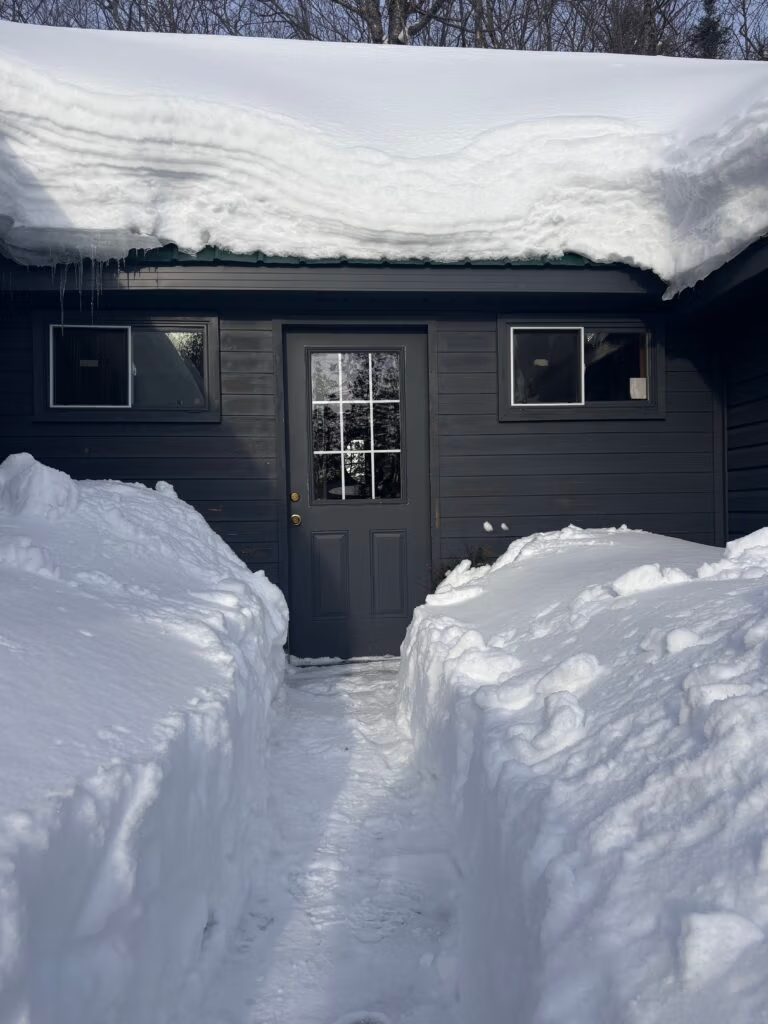
Last winter the snowpack was about 5 feet. To walk anywhere off trail you needed snowshoes, as big as you could find, so you wouldn’t sink. The Algonquin snowshoes we keep at the Log Cabin were perfect. The small modern snowshoes with crampons? Useless. They sank almost halfway.
The shape and size of a snowshoe are what matter, and every shape tells you where it came from. Each nation built its snowshoe for the land it walked:
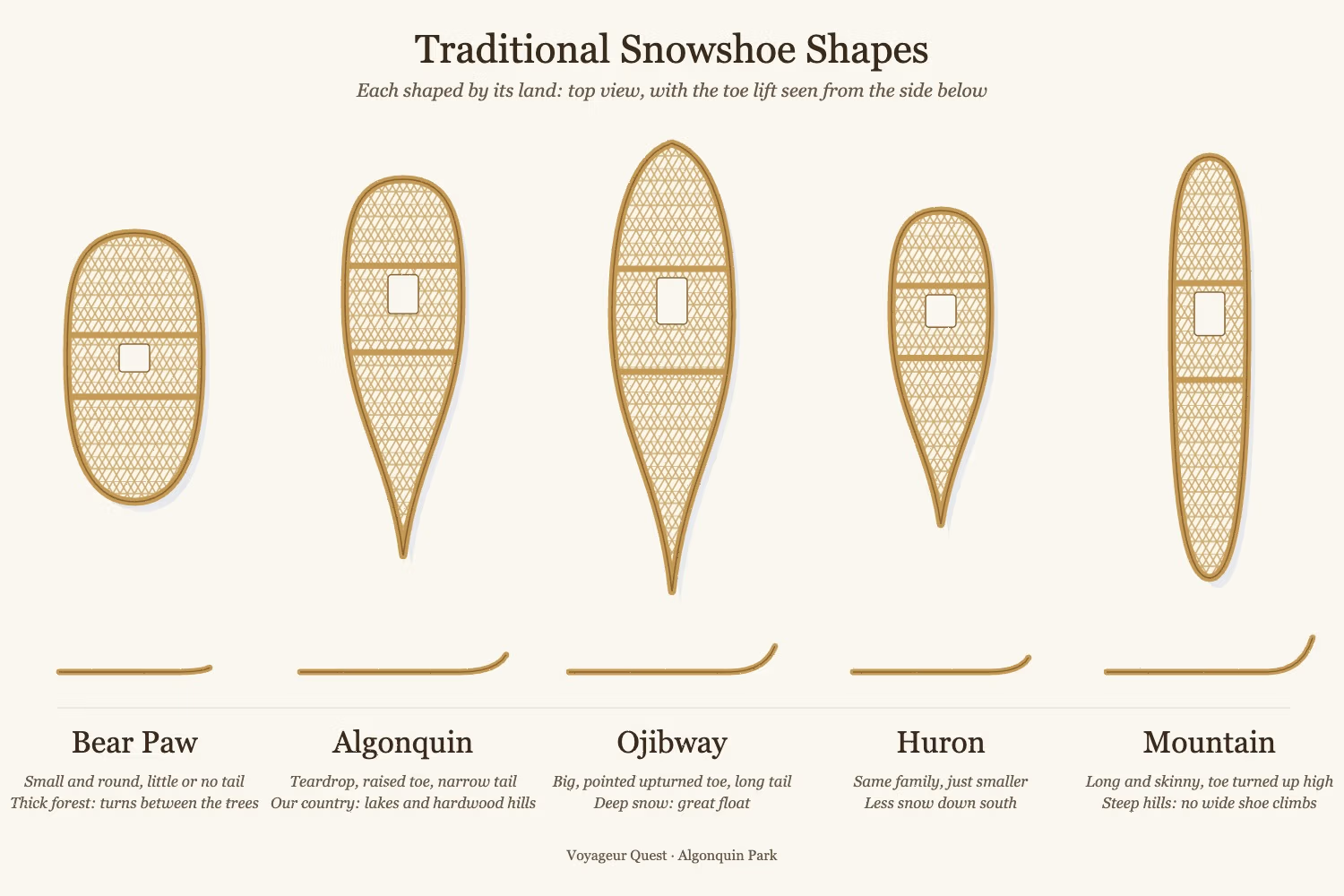
- Bear paw: made for thick forest. Small and rounded, with little or no tail, so it turns easily between the trees and through the brush. When we winter travel, we travel on Ojibway shoes but carry a few pairs of bear paws for when we get to camp. To set up camp we need to get firewood, use saws and move around, and this is where bear paws shine.
- Algonquin: the snowshoe of this place, from the Ottawa Valley and the highlands around what is now Algonquin Park, where lakes and hardwood hills alternate. A teardrop shape with a raised, upturned front and a narrow tail, the style the Algonquin people favoured. That raised tip rides up over fresh, new snow instead of diving under it, so each step stays on top. The tail drags in the snow like a rudder, so the shoe tracks straight instead of swinging side to side: the pick for long crossings on frozen lakes. These are perfect for our winter travel trips.
- Ojibway: from the Great Lakes country to the west, a close neighbour and very similar to the Algonquin. It’s a big snowshoe that always has a tail, and the front is often pointed like the bow of a birchbark canoe, sometimes rounded. All that size means great float in deep snow.
- Huron: from the country around Georgian Bay and the St. Lawrence, and the third of the family: very similar to the Algonquin and the Ojibway. The same shape with a tail, just smaller, because there’s less snow down there. Less snow needs less float, so the shoe can be lighter and easier to handle. The Algonquin, Ojibway and Huron are really one shape, with small differences shaped by the land each nation travelled.
- Mountain: long and skinny, nothing like the wide Algonquin, with the toe turned up high like the front of a ski. It’s made for walking up hills, and you can’t climb in wide snowshoes: they knock together and won’t bite into the slope. The skinny body lets you step up the hill or cut across its side, and the high toe climbs over the snow instead of digging in. Most have no long tail to drag and catch; some still carry one, because even hill country has lakes to cross. (In the US it’s often called the Alaskan.)
Where they shine: off-trail through the bush after a big snowfall, long straight crossings on snowy frozen lakes (the Algonquin and Ojibway), rolling ground, and long quiet walks where you want to hear the forest. Where they struggle: ice, hard crust and steep climbs, since most have no metal grip underfoot.
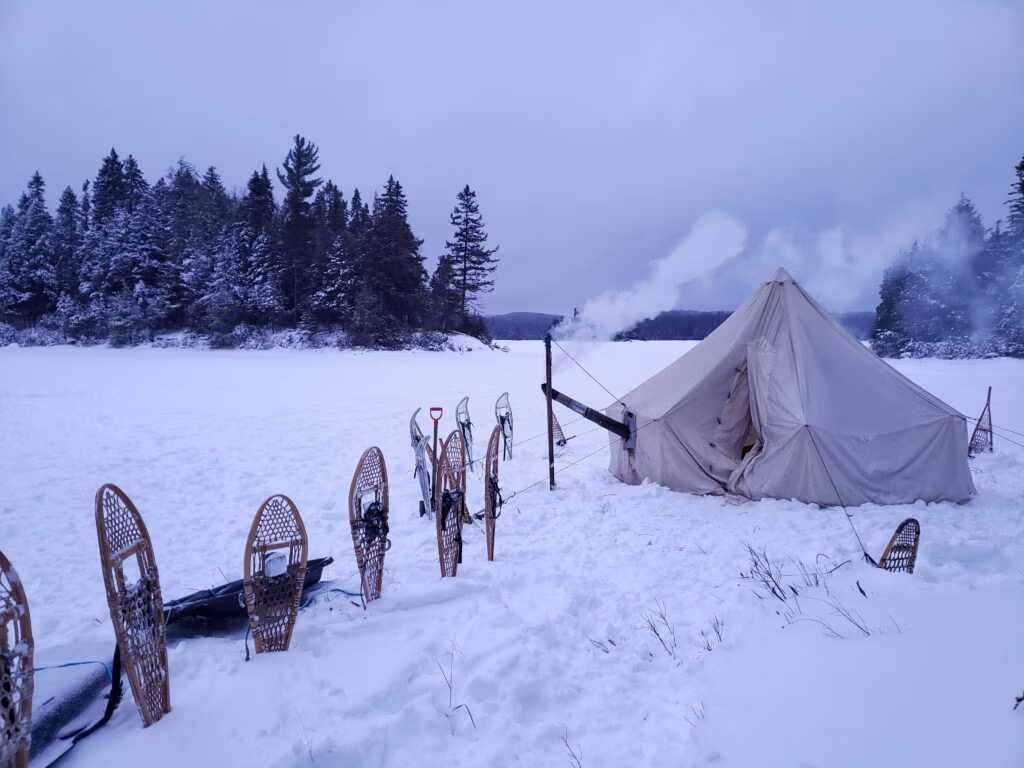
Learn from the expert: Craig Macdonald
If one person knows traditional snowshoes in Algonquin, it’s Craig Macdonald. A retired Algonquin Park recreation specialist, Craig spent 24 years working in the Park and has crossed it on snowshoes three times, each on a different route, using traditional Ojibway equipment and techniques. In 1993 he helped lead the Trans-Algonquin Snowshoe Expedition, two weeks south along the old ranger patrol routes from Cedar Lake toward Highway 60. He has logged well over 1,000 miles on snowshoes, and his collection of about 150 pairs of Indigenous-made snowshoes from all over North America, kept in Dwight, may be the finest in Canada. He takes it out to give a talk called “A Story of Snowshoes,” and his message is simple: “There are so many different types of snowshoes for different conditions.” Every one of those shapes was earned: “This is something that’s evolved over thousands of years.”
Craig wrote the book on it, literally: Traditional Sledding in North America (Canadian Canoe Museum, 2025, with 400 of his own hand-drawn illustrations) is called the “bible” of traditional winter travel, and his Historical Map of Temagami charts the old summer and winter routes. His story is told in James Raffan’s biography, Echo Maker (Dundurn). When we talk about how each shoe was shaped by its land, we’re standing on Craig’s work.
Modern snowshoes: made for grip and ease
An aluminum or plastic frame, a solid synthetic deck, and steel crampons under the ball of the foot. They’re smaller and lighter to carry, the bindings snap on over any winter boot in seconds, and many have a heel lift that flips up to save your calves on a climb.
Where they shine: packed trails, icy patches, hills and wind-scoured lakes, where those crampons bite and keep you steady. They’re also the easiest pair to learn on: no lacing, no fuss, just walk. We use them on our beaver pond trail: we snowshoe it often enough that the snow isn’t deep, and it’s quite steep, so the crampons help. Where they struggle: deep, fresh powder. With less surface area you sink deeper, and breaking trail after a storm is real work.
Bindings: what holds the shoe to your foot
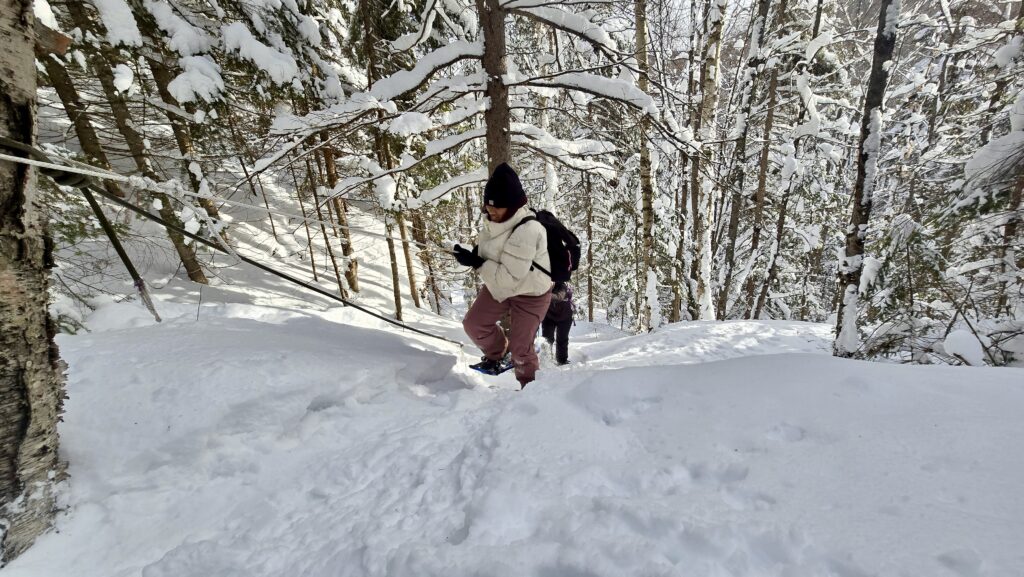
The binding matters as much as the frame. Your foot rides on the crossbar, toes dipping through the opening as you step, while the heel lifts free and the tail drags behind.
Whatever you wear, the binding should hold your foot snug and centred, so the shoe tracks straight and doesn’t flop.
Snowshoeing at Voyageur Quest
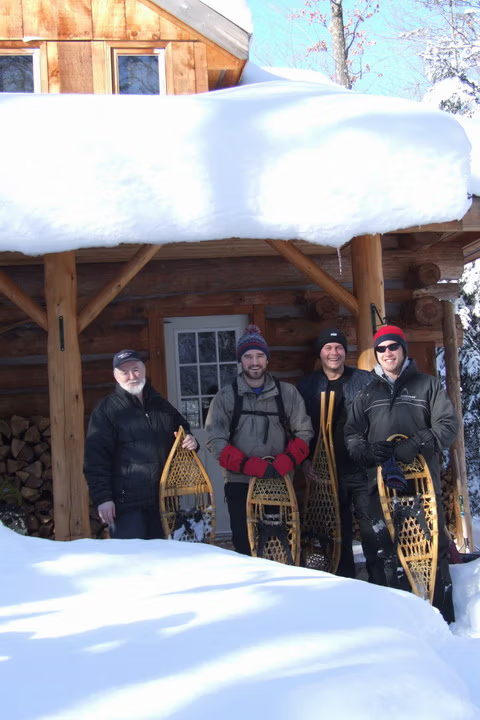
At Voyageur Quest you don’t have to choose before you come. On the 3-day Algonquin Winter Lodge Adventure, your guide picks the right pair for the day’s snow and the day’s route, then teaches you to read the tracks you find along the way: wolf, moose, marten, fox. Staying in the chalet on your own? With our Snowshoe & Chalet getaway, snowshoes come with your suite, and the trail starts at the front step. See all our ski and snowshoe adventures.
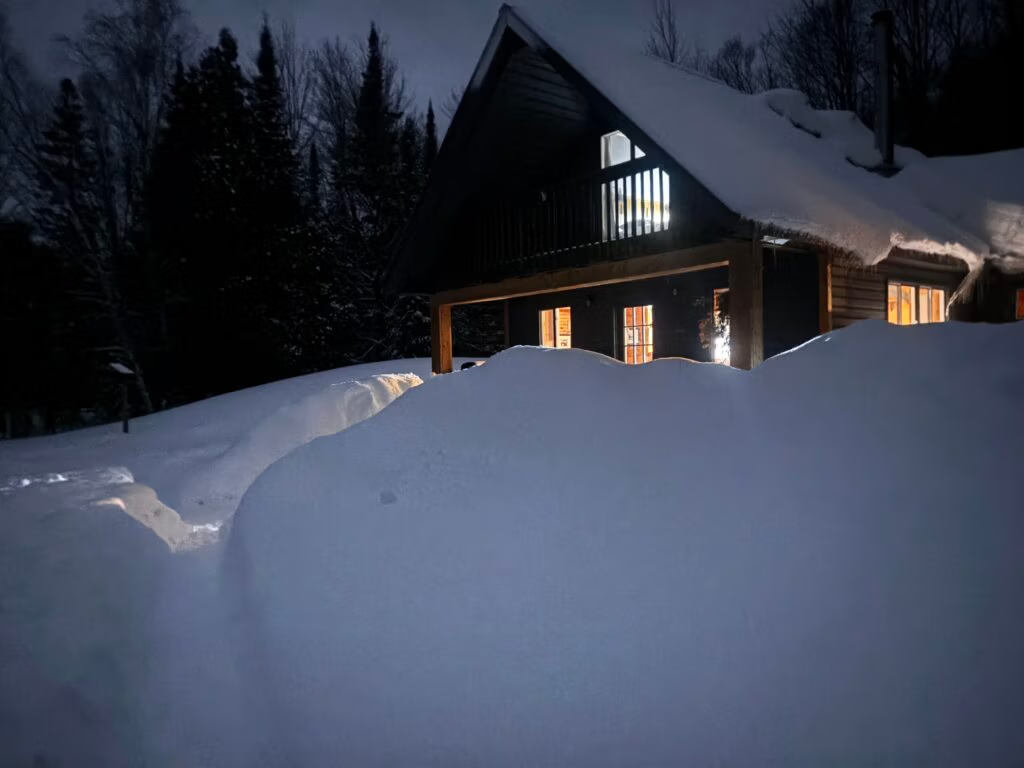
Whichever pair you strap on, the reward is the same: a silent white forest, a story written in the snow overnight. See you soon…
About the author: John Langford has been out on Algonquin’s snow every winter since 1991, the year he started Voyageur Quest. Our team teaches a new crew of snowshoers each season how to read the woods, one track at a time.